Now, before you expect anything majorly argumentative, the “tense” I am referring to is actually about verb tenses. I’ve noticed lately that certain Scriptures are given a verb tense for a particular reason, and if they aren’t understood, the context cannot be appreciated to its full extent. Here’s a starting example:
For many are called, but few are chosen. ~ Matthew 22:14
Before I became interested in studying the tense of words, I always struggled with this verse. How can we be called, but not chosen? This may be something you have seen already, but the Greek word for this term means invited. Now, that changes the picture. Another one, anyone?
Likewise the Spirit also helpeth our infirmities: for we know not what we should pray for as we ought: but the Spirit itself maketh intercession for us with groanings which cannot be uttered. And he that searcheth the hearts knoweth what is the mind of the Spirit, because he maketh intercession for the saints according to the will of God. And we know that all things work together for good to them that love God, to them who are the called according to his purpose. For whom he did foreknow, he also did predestinate to be conformed to the image of his Son, that he might be the firstborn among many brethren. Moreover whom he did predestinate, them he also called: and whom he called, them he also justified: and whom he justified, them he also glorified.
Romans 8:26-30
Before I go further, I’d suggest that you read the whole chapter since this post may not do justice to the whole message as I am focusing on a particular thing.
If you would, direct your attention to the phrase “to them who are the called according to his purpose.” The phrase, called, here also means invited. Now notice really quick how different it is when you read it in other versions…
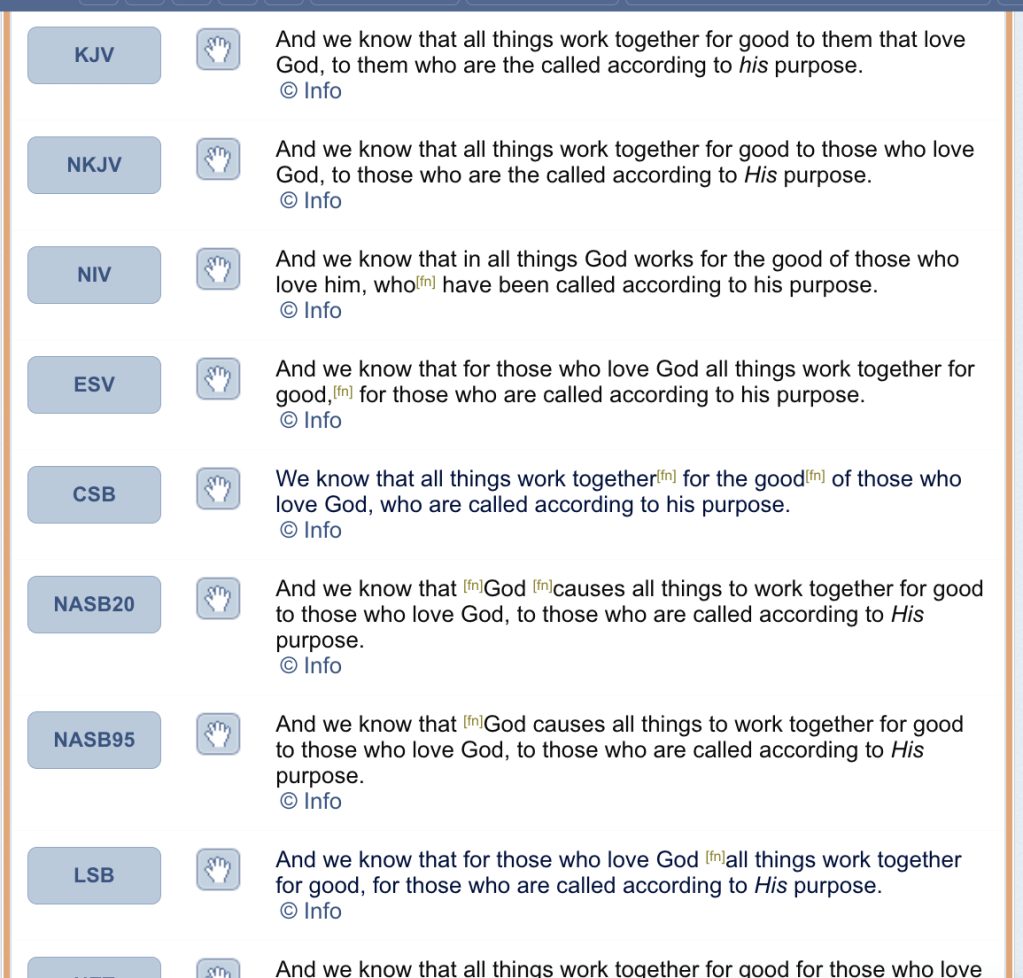
When you read it with no “the”, it sounds like it’s a selective verse, but when you add “the” to it, it shows that God’s purpose is that all are invited to the promise of Christ’s redeeming blood. The only thing is you have to accept the invitation. There’s a little tidbit.
Tenses
Now, not only does word choice and original word meaning help us understand the passage better, but also the tenses in which the verbs are written. When we look into that aspect of it, there’s a whole new understanding. Beginning with the Scripture above, let’s look at the following verbs:
- Foreknow
- Predestinate
- Called
- Justified
- Glorified
Beginning with foreknow, this word pictures unexplainable grace. The word shows, whom God knew beforehand. When you were in your mother’s womb, He knew you. This Greek word comes from two other roots: before and to know (before you are acquainted or know someone). The God of the Universe knows you. This isn’t some self-discovery thing but a truth that you are seen and here for a purpose. How about the next word?
Predestinate comes from a Greek word meaning to determine/decide beforehand. This word comes from two roots also: before and to define/determine/set boundaries for. So not only does He see you and has known you since your time in your mother’s womb, but He also has determined that the grace of Jesus’ redeeming blood is for everyone. It paints a further picture of grace. He knows you, sees you, and has included you and invited you for His purpose: to seek and save those who are lost.
Called: this word, although touched on earlier, pictures a God of extreme love and justice. It is the story of the Gospel. The God of the Bible did not just call a specific elite group of people. Those who lead you to believe that are not living by His purpose and Word. Don’t let those who do not live wholeheartedly for Him, change your decision. Continuing with that thought, everyone is invited to partake in the redemption of Jesus Christ. The next word is the biggest gap that can be found in the Bible. You could even say it’s roughly 12-18 inches. It’s between the mind and the heart. You can be invited, but if you do not accept the invitation and act on it, the redeeming action of Christ has no work on your life. It says that Christ died once and for all people. He died the most gruesome death (Many will argue, but He is the only one who had God’s wrath placed on Him; so yes, it was the most gruesome.). He went through God’s wrath for you. He was the sacrificial Lamb, so why would anyone want to not accept His sacrifice and still go through with being placed under God’s Judgment?
For God sent not his Son into the world to condemn the world; but that the world through him might be saved. He that believeth on him is not condemned: but he that believeth not is condemned already, because he hath not believed in the name of the only begotten Son of God. And this is the condemnation, that light is come into the world, and men loved darkness rather than light, because their deeds were evil.
John 3:17-19
You have been given a choice to know personally the freedom of the next word: justified.
Justified. This is my favorite word of the little group in the above Romans passage. When you are justified, the Greek word chosen shows that you are declared/pronounced/made righteous at that exact moment in time. How do I know when? Because of a little thing called verb tense. The verb tense of all these words is the aorist active indicative. Now what in the world does that mean? Glad you asked…
Aorist Active Indicative
Breaking it down, the aorist is about emphasis, active is the action, and indicative is the length. First, an aorist emphasizes the certainty/completion of the word. The active shows that it is still being applied and the indicative, states it is a fact. I know that didn’t do much to explain, but the whole concept is that it happened, is still affecting us, and will always. It shows God’s character: was, is, and always will be.
Continuing, glorified is our next word. This word shows that through adoption into the family of God by faith in Christ, we are clothed with holy splendor. We are no longer sinners doomed to die, but sinners saved by grace walking through to a glorious land. The root word it comes from shows that we are elevated to the glorious state of being part of the family of Christ, belonging to God, and no longer held in judgment. We are saved and redeemed, no longer to stand before the throne as a guilty convict but as one who has been released. That is the beauty of the gospel with a few verbs.
So, what do you think now about Greek derivatives and verb tenses? Hope you enjoyed it!

 Rooted in Him
Leave a comment